CoSphere-SLAM Paper

CoSphere-SLAM: Multi-Agent Panoramic Gaussian Splatting SLAM with Spherical Loop Closure

Qi Shao1,2, Zhihao Cao3,4, Shuhao Zhai5, Taoyu Wu2,6, Zhuoxiao Li7, Anh Nguyen2,8, Long Hu9, Xianzhi Li9, Hong Liang1, Baoru Huang2,8, Liang Li1

1Harbin Engineering University   2University of Liverpool   3ETH Zurich   4National University of Singapore   5University of Macau   6Xi’an Jiaotong-Liverpool University   7The Hong Kong University of Science and Technology (Guangzhou)   8Imperial College London   9Huazhong University of Science and Technology

Under Review

01Abstract

  • Problem. Dense collaborative mapping with multiple monocular panoramic cameras for search and rescue, building inspection and warehouse automation, without prior relative poses or scales between agents.
  • Challenge. Panoramic agents observe overlapping scenes at any 3D orientation, yet searching full rotations produces mutually consistent false closures across symmetric rooms, monocular scale drift splits rigidly merged maps, and short-baseline depth noise distorts loop translation directions.
  • Method. CoSphere-SLAM couples Spherical Loop Closure, which correlates spherical features over SO(3) and rejects symmetric closures through global Sim(3) consensus, Directional Global Optimization, which solves a per-keyframe Sim(3) pose graph separating optical-flow directions from depth-based magnitudes, and Omnidirectional Gaussian Fusion, which refines poses and maps along viewing rays.
  • Result. CoSphere-SLAM tracks every agent on 50 Holo360D scenes and 18 cross-session 360Loc recordings, reaching 0.082 m per-agent and 0.152 m joint ATE on the 45 test scenes and 0.30 m ATE across day and night sessions, with state-of-the-art trajectory accuracy and rendering quality among single-agent and multi-agent methods.
Full abstract

Dense collaborative mapping is essential for search and rescue, building inspection, and warehouse automation, where panoramic cameras capture the entire surroundings in a single frame. Unlike pinhole agents that share views only at similar headings, panoramic agents observe overlapping scenes at any 3D orientation, yet searching full rotations also produces mutually consistent false loop closures across distinct symmetric rooms. Moreover, continuous monocular scale drift splits rigidly merged maps at revisited surfaces, while depth noise at short baselines distorts loop translation directions. To address these challenges, we propose CoSphere-SLAM, the first multi-agent Gaussian splatting SLAM framework for panoramic cameras, whose spherical loop closure aligns spherical features over SO(3) via fast Fourier correlation across arbitrary orientations and rejects symmetric false closures through global Sim(3) consensus. Building on these closures, directional global optimization solves a per-keyframe Sim(3) pose graph with log-scale regularization to correct scale drift while separating optical-flow translation directions from depth-based magnitudes. Finally, omnidirectional Gaussian fusion transforms each Gaussian with its keyframe similarity and renders Gaussians at their maximum ray response to jointly refine poses and maps. Experiments on indoor and cross-session multi-agent panoramic benchmarks demonstrate that CoSphere-SLAM achieves state-of-the-art trajectory accuracy and rendering quality among single-agent and multi-agent methods. Code and benchmark tools will be publicly released.
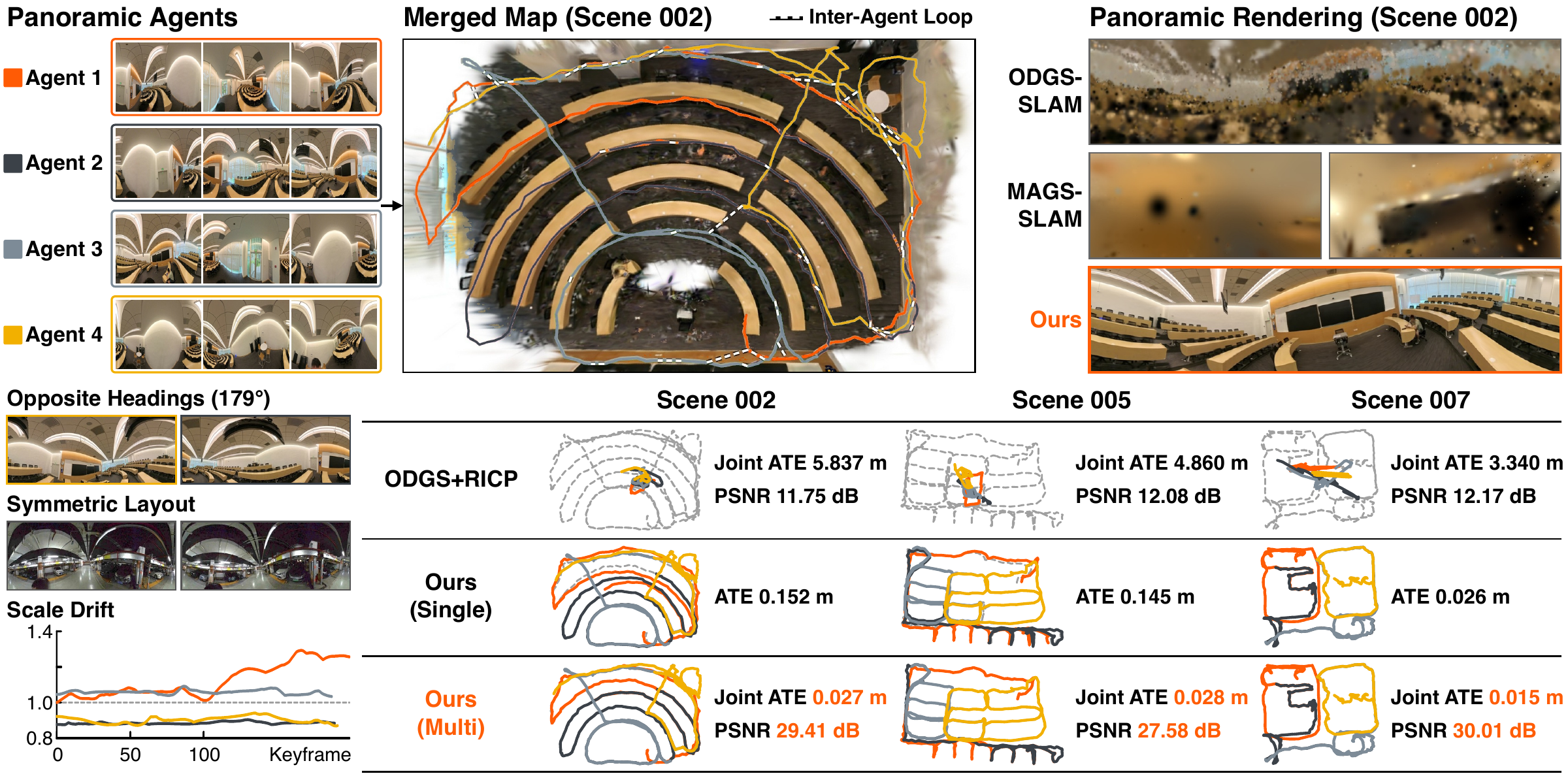
CoSphere-SLAM aligns four panoramic agents into one 3D Gaussian map

Swipe horizontally to inspect details

Figure 1. Collaborative panoramic Gaussian splatting SLAM with CoSphere-SLAM. Four monocular panoramic agents at top left are aligned into one 3D Gaussian map at top center with 360° rendering at top right on Scene 002. While the bottom left shows a loop closure at opposite headings, a symmetric layout, and scale drift, the bottom right compares trajectories, single-agent ATE or multi-agent joint ATE, and masked front-face PSNR across three development scenes against dashed ground truth, with RICP registering ODGS-SLAM maps via RANSAC and ICP.
Meetings connected by a verified loop closure across relative orientations

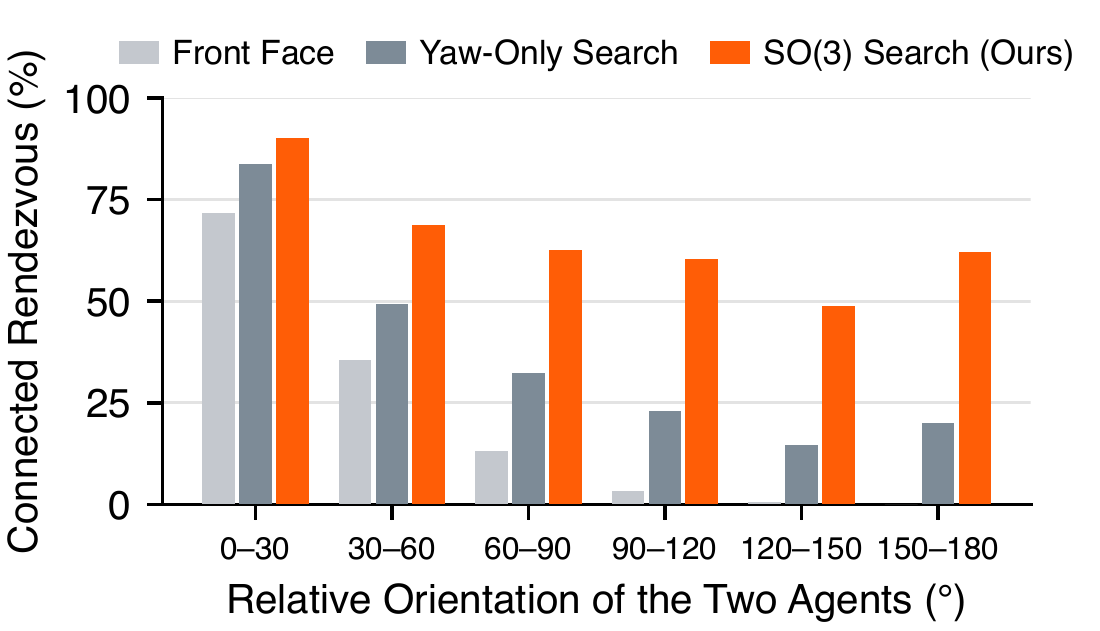
Figure 2. Fraction of inter-agent meetings connected by a verified loop closure across relative agent orientations on the development set.

02Collaborate on the Sphere

A monocular panorama observes the unit sphere S² without field-of-view limits. Viewing directions are therefore scale-free and shared at any heading, while discrete room symmetries and continuous radial scale remain unobservable within one view. CoSphere-SLAM resolves both ambiguities on the sphere:

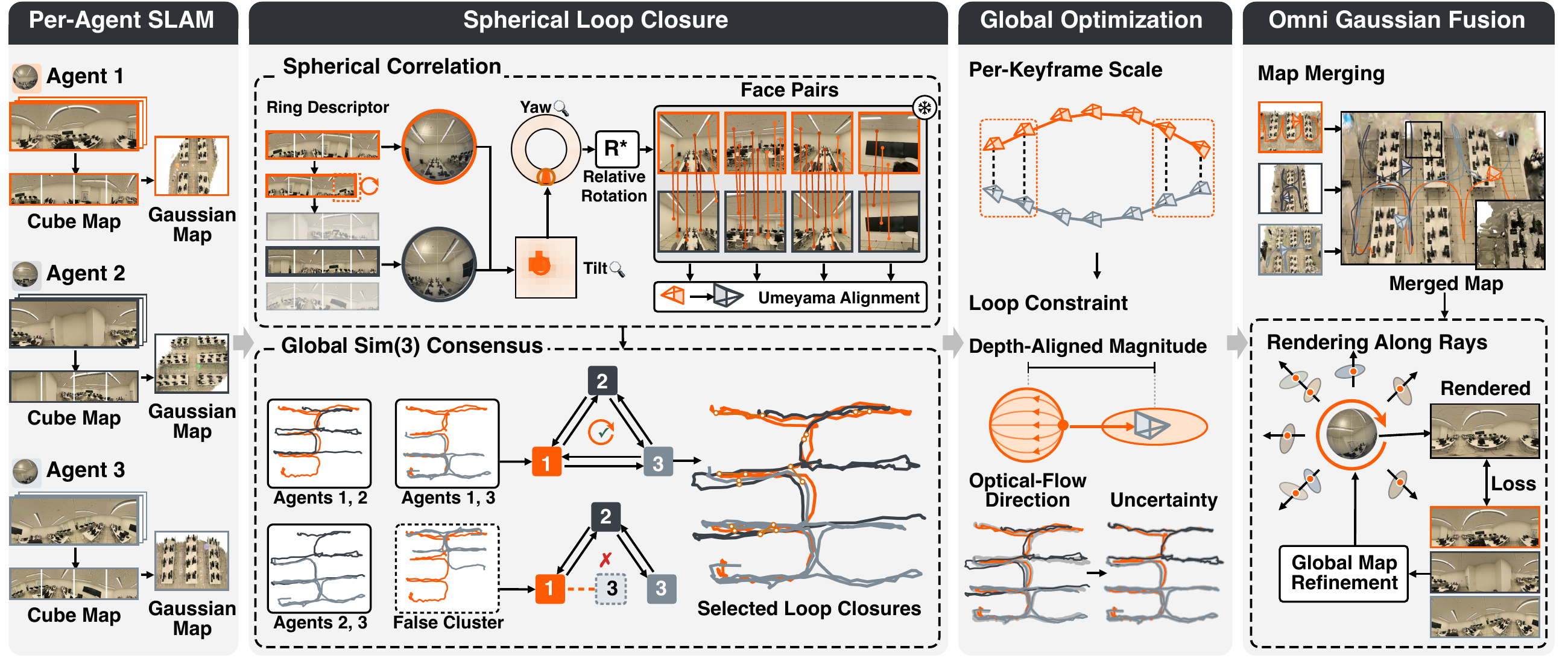
  1. Spherical Loop ClosureFactorizing a rotation into a 2D tilt and a yaw turns SO(3) search into a tilt grid with one circular FFT over longitude per tilt, and cycle-consistent global Sim(3) consensus rejects all 180 symmetric outliers above 10° while keeping 99.3% of true closures.
  2. Directional Global OptimizationA per-keyframe Sim(3) pose graph regularizes log-scale as a random walk to correct 11% median scale drift, taking loop translation directions from optical flow and magnitudes from depth alignment.
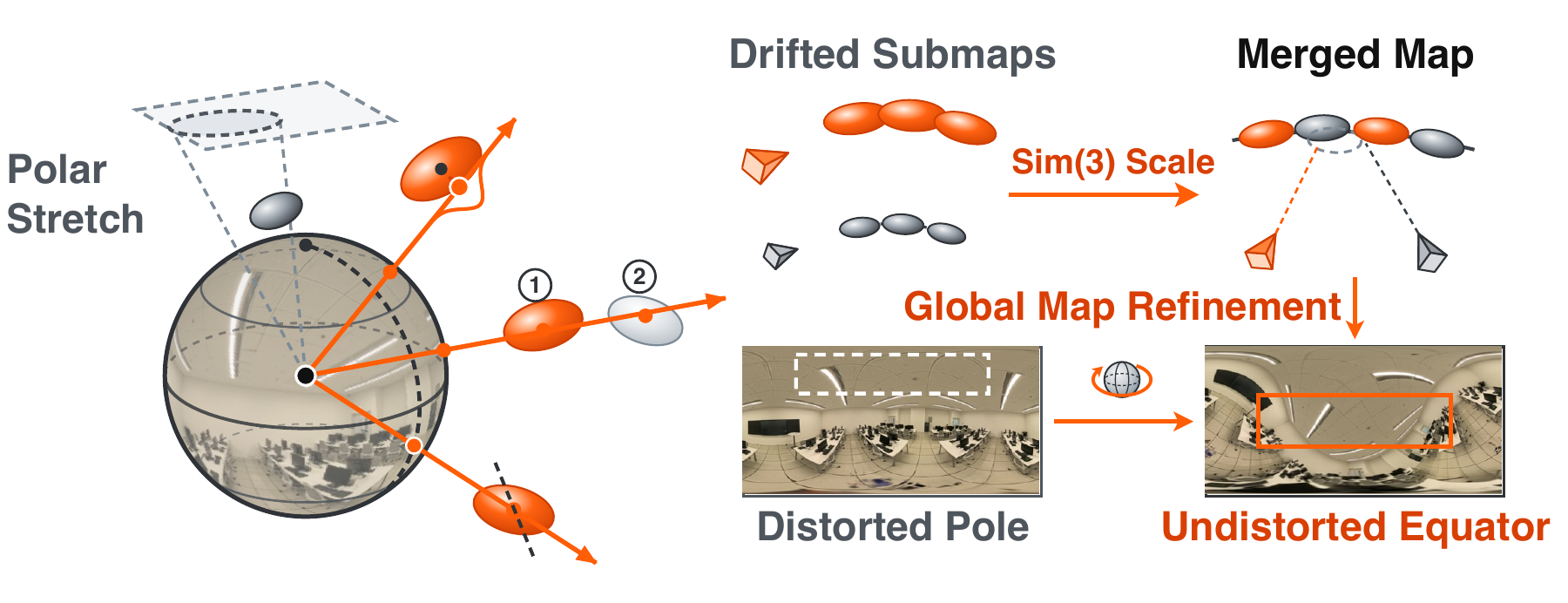
  3. Omnidirectional Gaussian FusionEach Gaussian moves with the similarity of its keyframe, and rendering at its maximum ray response refines all poses and maps without polar stretch or seam cuts.

03Method

Overview of CoSphere-SLAM

Swipe horizontally to inspect the full architecture

Figure 3. Overview of CoSphere-SLAM. Each agent resamples panoramas into six cube-map faces with scale-aligned depth to track poses and build local 3D Gaussians. On the server, spherical loop closure aligns spherical feature maps over SO(3) via circular FFT and removes symmetric false closures via global Sim(3) consensus across clusters and agent loops. Directional global optimization solves a per-keyframe Sim(3) pose graph separating optical-flow directions from depth-aligned magnitudes, and omnidirectional Gaussian fusion deforms Gaussians by their keyframe similarities to refine all poses and maps along viewing rays.

Omnidirectional Gaussian fusion along viewing rays

Figure 4. Omnidirectional Gaussian fusion. Left: evaluating Gaussians at their maximum ray response and compositing front to back avoids polar stretch and dashed seam cuts. Right: per-keyframe Sim(3) scaling forms the merged map while random 3D rotations move poles onto the equator for 2D SSIM supervision.

Per-agent tracking and mapping. Each agent tracks six 90° cube faces sharing one optical center with a DROID-SLAM front end, aligns per-face monocular depth into one spherical depth map, and sends a compact ring descriptor with every keyframe pose, running online at 1.0 input FPS in 7.8 GiB of GPU memory.

Rendering along viewing rays. Six-face rasterization inflates cube-seam gradients to 6.0M Gaussians, whereas ray evaluation keeps 0.50M and raises development WS-PSNR from 22.80 dB to 27.18 dB.

04Interactive Demo

Scene
Multi-Agent
Single-Agent
Loading
100% 0.8 m

Interactive demo. Keyframe trajectories of the four agents on the five development scenes, drawn over the merged Gaussian map of CoSphere-SLAM (Gaussian centers in their base color), with Agents 1 to 4 in orange, gunmetal, steel, and yellow as in the paper. Multi-Agent methods align all agents to the ground truth with one Sim(3), and Single-Agent methods align each agent on its own. Mean is the per-agent ATE (m) of Table 1, Joint is the error of all agents under one Sim(3), and a dagger marks a mean over the tracked agents. Drag to rotate, right-drag or Shift-drag to pan, and scroll to zoom. The ceiling cut hides the map above a height over the cameras so that the floor plan stays visible.

05Results

Qualitative Results

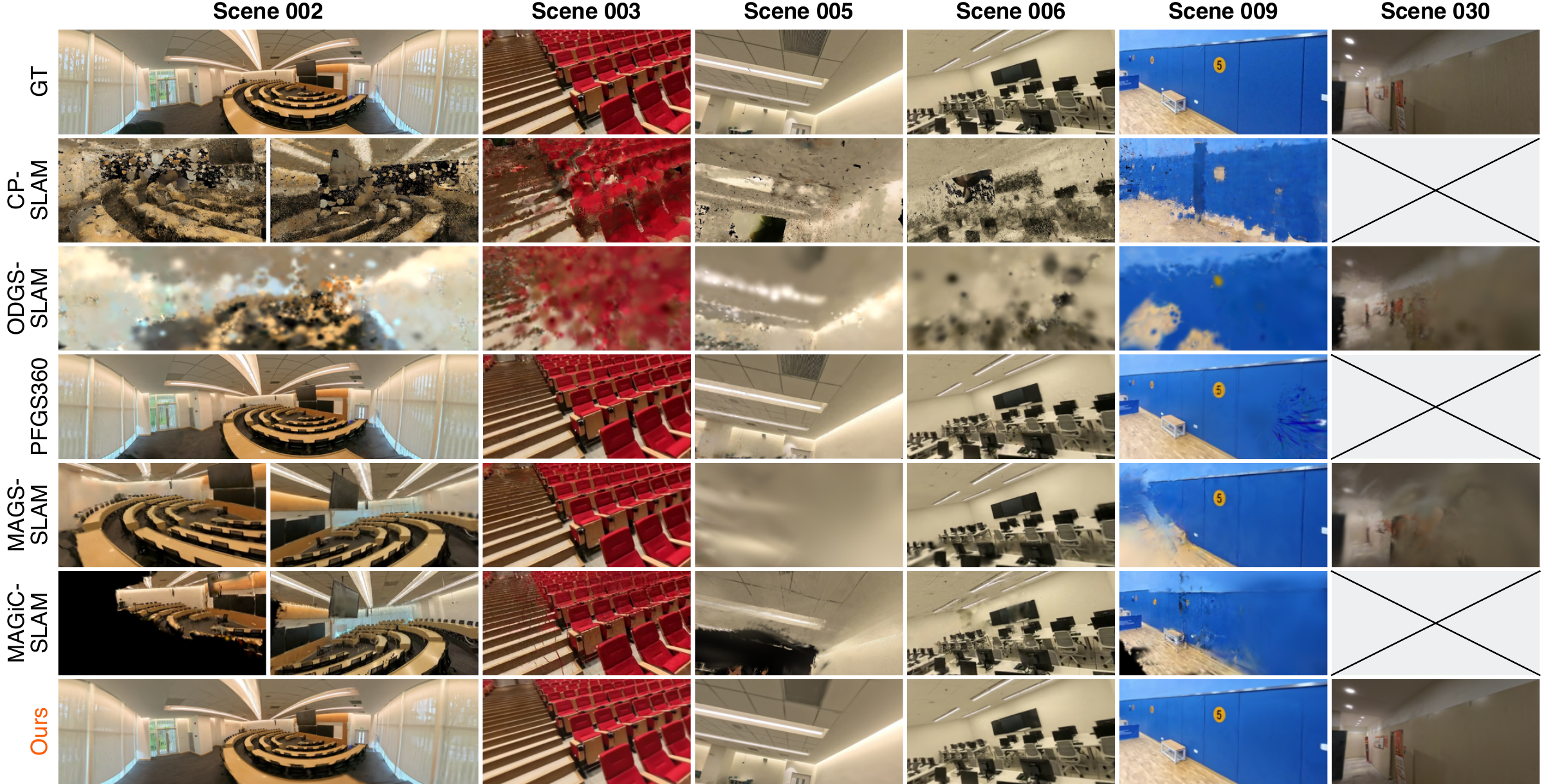
Qualitative results

Swipe horizontally to inspect details

06Ablation

  1. Spherical Loop ClosureBenefiting from full-sphere views, tilt search with FFT yaw correlation connects 62.2% of meetings beyond 150°, and cycle-consistent Sim(3) consensus lowers joint ATE on symmetric Scenes 001 and 021 from 7.545 m and 0.673 m to 0.314 m and 0.264 m. Replacing this backend with MAGS-SLAM association raises development joint ATE from 0.028 m to 1.329 m.
  2. Directional Global OptimizationRandom-walk log-scale regularization corrects 11% median scale drift and lowers test ATE from 0.144 m to 0.095 m, while taking translation directions from optical flow instead of depth lowers development ATE from 0.031 m to 0.021 m.
  3. Omnidirectional Gaussian FusionEvaluating Gaussians along viewing rays instead of six projective faces raises WS-PSNR from 22.80 dB to 27.18 dB, and joint Sim(3) refinement raises it from 17.81 dB to 27.80 dB while refining test ATE from 0.095 m to 0.082 m.

07BibTeX

@article{shao2026cosphereslam,
  title   = {{CoSphere-SLAM}: Multi-Agent Panoramic {G}aussian Splatting {SLAM} with Spherical Loop Closure},
  author  = {Shao, Qi and Cao, Zhihao and Zhai, Shuhao and Wu, Taoyu and Li, Zhuoxiao and Nguyen, Anh and Hu, Long and Li, Xianzhi and Liang, Hong and Huang, Baoru and Li, Liang},
  journal = {arXiv preprint arXiv:2611.22235},
  year    = {2026}
}

08Supplementary Material

The supplementary material provides the following details beyond the main paper.

S1Parameters

All hyperparameters of the panoramic agents, spherical loop closure, directional global optimization and omnidirectional Gaussian fusion, fixed across Holo360D and 360Loc.

S2Results on All Scenes

Per-agent ATE of every method on all 50 Holo360D scenes, and estimated trajectories on four development scenes.

S3Additional Analysis

Single-agent tracking, joint pose-graph optimization, revisit closures, the drifted corridor branch of Scene 027, the symmetric Scenes 001 and 021, and communication and runtime.

S4Implementation Details

Cube-map rig, panoramic depth prior, spherical Gaussian map, compact messages, ring descriptor, geometric verification, cluster selection, loop constraint and pose graph, loop noise model, map merging and global refinement, and loop closure thresholds.

S5Derivations

Spherical correlation, cycle consistency, per-keyframe scale, the loop constraint, rendering along rays, and map merging.

S6Benchmark and Baseline Protocol

How the multi-agent Holo360D benchmark is built from single sequences, how each baseline is run, and the protocol behind Figure 1.

S7Rendering Quality

Front-face rendering on the test scenes with SSIM and masked metrics, and an omnidirectional 3DGS comparison at 2048 × 1024 with multi-agent scene coverage.

S8Results on 360Loc

Per-session ATE, joint ATE and verified cross-session closures for each building, and all multi-session baselines across the 18 day and night sessions.

S9Sensitivity

One-at-a-time sweeps of the cluster radius, robust kernel and scale random-walk regularization over the 45 test scenes.

S10Module Replacements

Replacing the backend with MAGS-SLAM association, SO(3) search with yaw-only search, flow directions with depth directions, and ray evaluation with projective cube-face 3DGS.

S11Inter-Agent Meetings by Relative Orientation

Fraction of inter-agent meetings connected by a verified closure in each relative-orientation bin, against yaw-only search and front-face matching.